
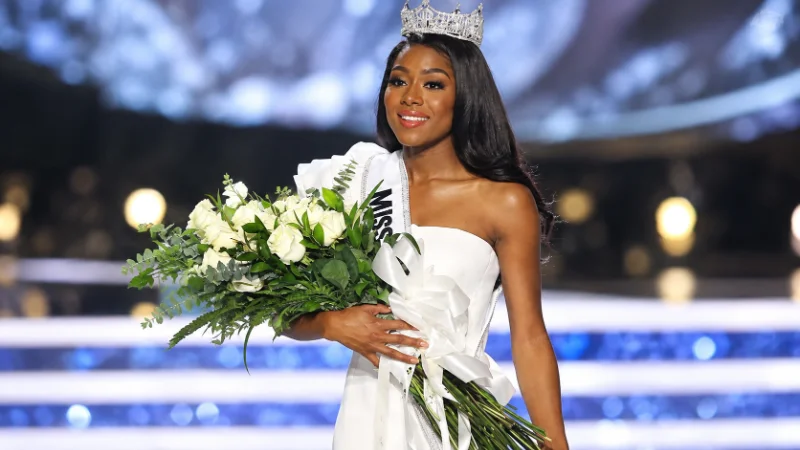
Nia Imani Franklin is an American composer and singer who was crowned Miss America 2019, and in the years since her reign ended she has built an actual working career in classical and popular music. She has written pieces performed by the Dallas Symphony Orchestra, the Charlotte Symphony, the Winston-Salem Symphony, the Friction Quartet and the Saskatoon Symphony Orchestra, held three separate composer-in-residence appointments, and picked up millions of views on TikTok along the way. Most coverage of Franklin stops at the pageant stage, treating the crown as the finish line rather than a detour. The more interesting part of her story starts after it came off, and headlines still often shorten her name to simply Nia Franklin.
Quick Facts
| Category | Details |
|---|---|
| Full Name | Nia Imani Franklin |
| Also Known As | Nia Franklin, Nia Imani (stage name) |
| Born | July 27, 1993, Winston-Salem, North Carolina |
| Profession | Composer, singer, conductor |
| Known For | Miss America 2019; composer of Chrysalis Extended, Polaris, and Tides |
| Education | B.M., Music Composition, East Carolina University (2015); M.M., Composition, University of North Carolina School of the Arts (2017) |
| Pageant Titles | Miss New York 2018; Miss America 2019 |
| Founder Of | Compose Her (2019), an initiative supporting women in music |
| Composer Residencies | Festival Napa Valley (2021), Music Academy of the West (2023), American Library in Paris (2024) |
| Notable Awards | Darioush and Shahpar Khaledi Prize for Excellence and Innovation in Classical Music (2021) |
| Board Roles | Opera On Tap; UNCSA Board of Trustees (Board Secretary, since 2023) |
| Social Media | Instagram & TikTok: @niaimanifranklin |
Early Life and Musical Beginnings
Franklin was born on July 27, 1993, in Winston-Salem, North Carolina, the oldest daughter of James and Kristy Franklin. She has a younger sister, Bailey, and a younger brother, J.D. Music entered her life early: she took classical voice lessons and wrote her first song by age six.
She has said that growing up as one of only a small percentage of minority students at a predominantly white school left her feeling out of place, until music gave her a way to feel positive about her own identity. She graduated from North Davidson High School in the Lexington, North Carolina area in 2011, already set on studying composition at the college level. Winston-Salem would remain central to her story well beyond childhood, later welcoming her home for a symphony performance and a seat on a university board.
Education: The Making of a Composer
Franklin enrolled at East Carolina University in Greenville, North Carolina, to study music composition, and during her freshman year her father was diagnosed with non-Hodgkin lymphoma. He later relapsed twice and needed a stem cell transplant, and Franklin turned out to be a match; her donation helped send him into remission. It is a personal chapter she has referenced often when explaining why both arts advocacy and cancer research matter to her.
In April 2015, her senior composition recital featured the world premiere of her own chamber opera, King Solomon, staged with a sixteen-member cast and a twelve-member orchestra. One of her composition professors at East Carolina later described her as encouraging with her fellow students and eager to collaborate on ambitious projects. After earning her bachelor’s degree, Franklin moved on to the University of North Carolina School of the Arts, where she completed her Master of Music in composition in 2017. She has said her professor Lawrence Dillon’s approach to music matched her own instincts closely enough that studying with him confirmed she was on the right track.
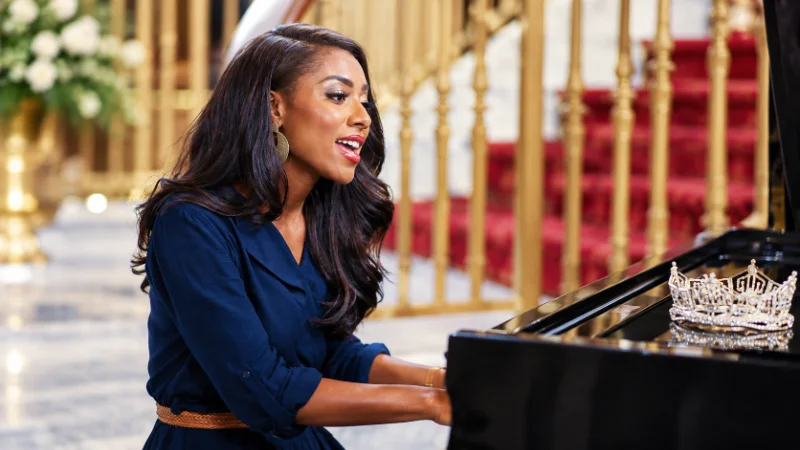
That same year, she was named a William R. Kenan Jr. Fellow with Lincoln Center Education, a role that took her to New York City. While there, she founded a music club through a partnership with Success Academy Charter Schools and worked as a cultural partner with the nonprofit Sing For Hope. As a graduate student, she had also volunteered with ArtistCorps, an AmeriCorps program that places artists in schools and community centers with limited access to arts programming.
From Pageant Stage to National Crown
Franklin’s pageant career began almost by accident, as a way to fund her education. While at East Carolina University, she won the Miss Black and Gold scholarship pageant sponsored by the school’s Alpha Phi Alpha chapter, then competed in the Miss North Carolina organization in 2016 and 2017, reaching the top ten and winning the preliminary talent award both times. She became only the second North Carolina native to hold the Miss America title.
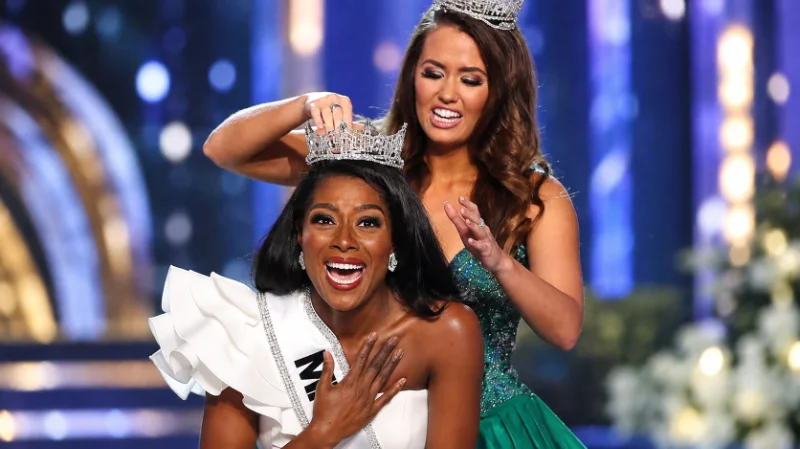
After her move to New York, Franklin competed as Miss Five Boroughs at the 2018 Miss New York pageant, winning the talent and swimsuit preliminaries along with the overall interview award, and was crowned Miss New York on June 30, 2018, at Shea’s Theatre in Buffalo. That September, representing New York at Boardwalk Hall in Atlantic City, she won Miss America 2019 on a platform called Advocating for the Arts, singing the aria “Quando m’en vò” from Puccini’s La bohème for the talent portion and defeating first runner-up Bridget Oei of Connecticut. Asked onstage by judge Laila Ali how being Miss New York prepared her for the national title, Franklin pointed to the grit she had built moving through New York City on a fellowship budget.
It was the first Miss America pageant held without a swimsuit competition, and Franklin walked away with a $50,000 scholarship as the seventh Miss New York titleholder to win the national crown. Her win also made 2019 the first year in which Miss America, Miss USA, Miss Teen USA and Miss Universe were all held by Black women, a moment widely covered as a turning point for the pageant world.
Life After the Crown: Building a Composing Career
During her year as titleholder, Franklin toured extensively, appearing on Good Morning America and Live with Kelly and Ryan, speaking to a national gathering of the American Society of Composers, Authors and Publishers, and performing for U.S. troops stationed in Europe and Africa through the USO. She also emceed a New York Philharmonic charity concert offering discounted tickets to first responders and their families, and took part in a UNCSA panel on women’s role in the arts.
When her reign ended in December 2019, the pandemic soon followed, and Franklin spent much of 2020 composing at home rather than performing. That focused stretch fed directly into 2021, when she became only the second composer-in-residence in the history of Festival Napa Valley, where she premiered several new works, including a solo cello piece called Afro-dite inspired by Botticelli’s Primavera and Greek mythology, and received the Darioush and Shahpar Khaledi Prize for Excellence and Innovation in Classical Music.
That September, performing under the stage name Nia Imani, she released her debut EP, Extended, a set of original R&B songs paired with an orchestral piece called Chrysalis Extended that eventually drew nearly four million views on her TikTok account. By late 2022 that account had grown to almost 145,000 followers. Franklin has said the attention mattered to her less as a viral moment and more as proof that composers do not have to look like Mozart or Bach, since many viewers had never before seen a woman of color in that role.
Expanding Her Repertoire
The commissions kept coming after that first residency. In February 2022, the Duward Ensemble premiered Franklin’s chamber piece Vingt-Huit at her alma mater, East Carolina University. That April, she performed at National Sawdust in Brooklyn as part of a program spotlighting American women composers, sharing the bill with music by Missy Mazzoli, Jessie Montgomery and Tomeka Reid.
Then, in July 2022, Festival Napa Valley commissioned her choral piece Polaris, written to mark Juneteenth’s designation as a federal holiday and performed by the Young People’s Chorus of New York City. That same year, Franklin was named one of four inaugural co-chairs of the White House Historical Association’s Next-Gen Leaders initiative and sang the national anthem at the unveiling of the Association’s official portraits of former President Barack Obama and First Lady Michelle Obama.
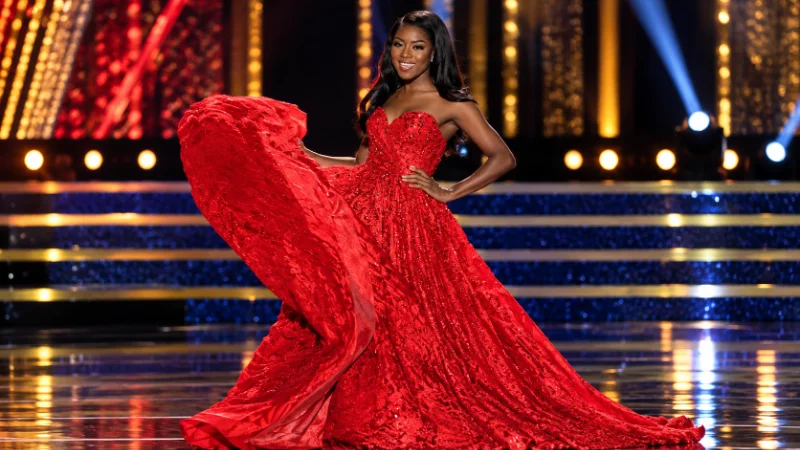
In January 2023, she returned to her hometown to perform a program of her own classical, pop and gospel works with members of the Winston-Salem Symphony. Later that year, she took on a residency at the Music Academy of the West in Santa Barbara, where she premiered a commissioned piece titled Tides. In 2024, Franklin wrote her first score for dance, collaborating with choreographer Sidra Bell on The Gardens That Were Watered for Us, a piece she has described as a tribute to Black culture, women and sisterhood, which premiered at UNCSA’s Winter Dance program.
That March, the American Library in Paris named her its first-ever composer-in-residence, a post supported by the Florence Gould Foundation and the American Center for Art and Culture. During the residency she performed jazz standards, spirituals and songs from Extended alongside a cellist and a pianist. She returned to Winston-Salem again that May for a symphony program built around gospel and R&B favorites, closing out a year that had carried her from a Paris library stage to the concert hall where her career first took shape.
Advocacy and Leadership Beyond the Stage
Franklin founded Compose Her in 2019, an initiative built to support and encourage women in music, offering composition workshops for students in kindergarten through twelfth grade. She has described the goal in personal terms, saying she wants to be the voice and advocate for girls who never imagined they could write and notate their own compositions.
She also serves on the board of Opera On Tap, a New York nonprofit working to make opera more accessible to broader audiences, and in 2023 she was appointed to the University of North Carolina School of the Arts Board of Trustees, where she now serves as board secretary. A former board chair at the school has praised her as an arts entrepreneur who treats creative work as a tool for social and economic equity, not just performance. Each role extends the same argument Franklin made as Miss America: that arts education changes lives, and that young women rarely get to see composers who look like them.
Why Her Story Stands Out
Plenty of pageant winners fade from public view once their reign ends. Franklin’s path went the other direction. She has spent the years since 2019 accumulating orchestra commissions, artist residencies on two continents, a genuine social media following built on original music rather than pageant nostalgia, and a nonprofit that has outlasted any single title.
The crown opened doors most classical composers never get near. The compositions, the residencies and the board seats are what kept those doors open long after the sash came off.