

Roger Hargreaves was an English author, illustrator, and cartoonist best known for creating the Mr. Men and Little Miss children’s book series. Born on May 9, 1935, in Cleckheaton, West Yorkshire, he first built a career in advertising before turning a simple question from his young son into the idea that became Mr. Tickle and eventually a worldwide publishing phenomenon.
His work succeeded because the concept was unusually simple. Each character could be understood through a recognizable personality trait, while the short stories, bright artwork, and humor made the books accessible to young readers. The official Mr. Men history says the characters began in 1971, while the series has since reached multiple generations of readers.
| Category | Details |
|---|---|
| Full Name | Charles Roger Hargreaves |
| Born | May 9, 1935 |
| Birthplace | Cleckheaton, West Yorkshire, England |
| Profession | Author, illustrator, cartoonist, advertising creative |
| Best Known For | Creating the Mr. Men and Little Miss children’s book series |
| First Mr. Men Book | Mr. Tickle |
| Mr. Men Series Began | 1971 |
| Little Miss Series Began | 1981 |
| Advertising Career | Worked as a copywriter and later creative director before becoming a full-time children’s author |
| Family | Married to Christine Hargreaves; father of four children |
| Son | Adam Hargreaves later continued creating Mr. Men and Little Miss books |
| Died | September 11, 1988 |
| Age at Death | 53 |
| Known For | Simple character designs, personality-based characters, and short humorous children’s stories |
| Major Legacy | Creator of one of the most recognizable children’s character franchises, which continued expanding after his death |
Early Life and Education
Charles Roger Hargreaves was born in Cleckheaton, a town in West Yorkshire, on May 9, 1935. The official Mr. Men history records that he showed an interest in drawing from an early age and had a natural talent for cartoons.
Before becoming a children’s author, he attended Sowerby Bridge Grammar School and spent a short period working in his father’s laundry and dry-cleaning business. He eventually moved into advertising, a career that gave him professional experience in writing, visual communication, and commercial creativity.
That advertising background is useful when looking at his later children’s books. His characters were visually uncomplicated, easy to recognize, and built around one clear personality. Those qualities made the books immediately understandable without requiring elaborate illustrations or lengthy explanations.
From Advertising Copywriter to Children’s Author
Hargreaves began working as a copywriter in advertising in 1957. According to the official Mr. Men history, he wrote advertising material for products ranging from chocolate to cars and eventually became successful within the industry.
By the late 1960s, he was working as a creative director. His advertising experience mattered because it taught him how to communicate an idea quickly. Instead of relying on complicated descriptions, he could reduce an idea to a memorable image and a few words.
At the same time, he had an ambition to create children’s books. The official history explains that after marrying and having children, he wanted a career that would allow him to spend more time with his family.
The Question That Created Mr. Tickle
The story behind Mr. Tickle has become one of the defining parts of Hargreaves’ biography. In 1971, his eight-year-old son Adam asked him what a tickle looked like. Hargreaves began thinking about the question and eventually drew a character with a round body and unusually long arms. That character became Mr. Tickle.
The idea worked because Hargreaves turned an abstract action into a character that children could immediately understand. Mr. Tickle was not introduced through complicated world-building. His appearance and behavior communicated the joke almost instantly.
The first Mr. Men book, Mr. Tickle, was published in August 1971. Finding a publisher was not immediate, with the Royal Mint noting that several traditional publishers initially rejected the idea. Once the books reached readers, however, the concept found a much larger audience.
The Rapid Growth of Mr. Men
Mr. Tickle was followed by characters including Mr. Happy, Mr. Greedy, Mr. Nosey, and Mr. Sneeze. The formula was straightforward: each character represented a recognizable personality, habit, or behavior, and the story placed that trait into a humorous situation.
The books quickly developed a strong readership. The Royal Mint reports that the series sold more than one million copies during its first three years. That early performance helped move Mr. Men beyond the boundaries of a new children’s book idea and into television and other forms of entertainment.
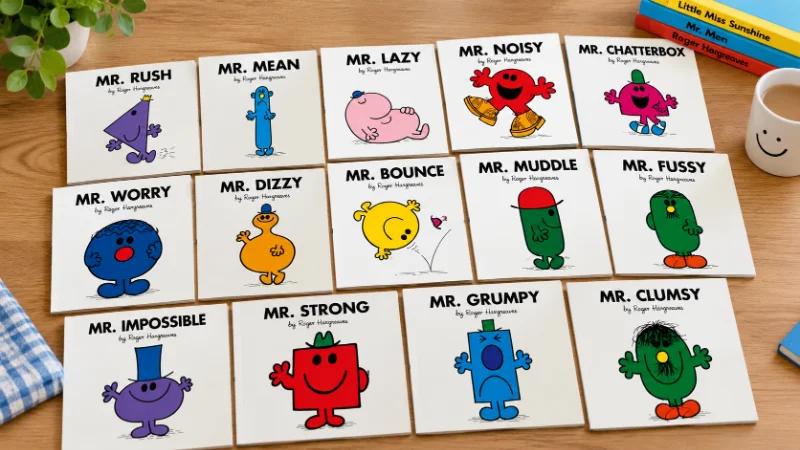
By 1974, the characters had reached television in a BBC animated series narrated by actor Arthur Lowe. The move to television introduced the characters to another audience while retaining the visual simplicity that made the books recognizable.
The success also allowed Hargreaves to leave his advertising career. Sources commonly place that transition around 1976, after the children’s books had become commercially established.
Building the Little Miss Series
Hargreaves did not stop with the Mr. Men characters. In 1981, he introduced the Little Miss series, creating a parallel collection of characters based around distinct personalities.
The first titles included Little Miss Bossy, Little Miss Naughty, Little Miss Neat, Little Miss Sunshine, and Little Miss Tiny. The series expanded the original idea while giving Hargreaves another way to explore personality through simple character design and short stories.
The official Mr. Men history connects the expansion to his family, noting that his daughters helped inspire the move toward Little Miss characters. This gave the growing fictional universe a broader cast without requiring Hargreaves to abandon the basic concept that had made Mr. Men successful.
Other Books and Creative Projects
Although Mr. Men and Little Miss became his best-known creations, Hargreaves worked on other children’s stories as well. His wider body of work included the Timbuctoo series, John Mouse, Roundy and Squary, and other character-based books.
Timbuctoo is particularly useful when considering the breadth of his career. It shows that his creative interests were not limited to the Mr. Men formula, even though that series eventually became his defining achievement.
His books generally favored visual clarity and short-form storytelling. Instead of building long fictional narratives, he could establish a character through a name, appearance, behavior, and a simple problem. That structure helped the books communicate quickly to young readers.
Family and Adam Hargreaves
Family was closely connected to the origins of Hargreaves’ most famous work. He and his wife, Christine Hargreaves, had four children, including Adam, Giles, and twins Sophie and Amelia.
Adam’s childhood question about what a tickle looked like directly inspired the creation of Mr. Tickle. That makes the story unusual because the central idea behind a major children’s publishing series emerged from an interaction between a father and his child rather than from a formal publishing plan.

Adam later became an author and illustrator himself and continued working with the Mr. Men and Little Miss characters after his father’s death. Penguin Random House identifies Adam as the person who currently oversees the estate and creates illustrations for new Mr. Men books.
Television and Wider Popularity
The transition from books to television helped establish the characters beyond the printed page. The first Mr. Men television series appeared in 1974, with Arthur Lowe providing narration. A further series followed the next year.
The Little Miss characters later received their own animated television treatment. The combination of books and television meant that the characters could reach children through different forms of entertainment while retaining the same recognizable designs.
The characters also moved into other forms of merchandise and popular culture. By the end of the 1970s, Mr. Men could be found in books, television, newspaper comic strips, and recordings, according to the Royal Mint’s history of the franchise.
Roger Hargreaves’ Writing and Illustration Style
The lasting appeal of Hargreaves’ work comes partly from restraint. His drawings did not depend on elaborate backgrounds or complicated visual effects. A simple shape, a strong color, an expressive face, and a personality-based name could tell readers what they needed to know.
The same principle applied to the writing. A character such as Mr. Happy or Little Miss Bossy could be understood before the reader had finished the first page. The stories then gave that personality a situation in which its strengths, weaknesses, or habits became funny.
This approach also made the characters easy to remember. Children could identify with one character, recognize another in a friend or family member, and return to the same world through different books.
Final Years and Death
Hargreaves continued creating children’s books during the 1980s as the Mr. Men and Little Miss worlds expanded. He lived with his family on Guernsey for several years before the family later settled at Sussex House Farm near Cowden, Kent.

Roger Hargreaves died on September 11, 1988, in Tunbridge Wells, Kent, at the age of 53. His death ended a relatively short but highly productive career in children’s publishing.
The Legacy of Roger Hargreaves
Hargreaves’ influence continued after his death because the characters he created were designed to function independently of their creator’s lifetime. Adam Hargreaves eventually continued writing and illustrating new Mr. Men and Little Miss stories, allowing the fictional world to keep expanding.
The scale of the franchise is also significant. Public reference sources report that the books have sold more than 85 million copies worldwide and have appeared in 20 languages. These figures describe the wider Mr. Men and Little Miss publishing legacy rather than sales during Hargreaves’ lifetime alone.
The Royal Mint also commemorated 50 years of Mr. Men and Little Miss, reflecting how the characters had become part of popular culture decades after their creation. In 2021, Hargreaves was posthumously awarded a Blue Peter gold badge.
Google also marked what would have been his 76th birthday in 2011 with a series of 16 Google Doodles on its global homepage. That recognition illustrates how far the characters had traveled from their beginning as drawings made by an advertising copywriter.
What makes Roger Hargreaves’ story distinctive is the smallness of the original idea. A child’s question became a drawing, the drawing became a book, and the book became a large fictional universe that continued long after its creator died.
His career also shows how skills developed in one profession can shape another. Advertising taught him to communicate ideas quickly, while his interest in drawing gave those ideas a visual identity. The combination produced a style that was simple enough for young children to understand and memorable enough to remain recognizable for generations.
Roger Hargreaves died at only 53, but the characters he created continued to develop after him. His name remains closely connected with Mr. Men and Little Miss, the two series that transformed his playful approach to personality and illustration into one of the most recognizable children’s publishing properties of his era.