
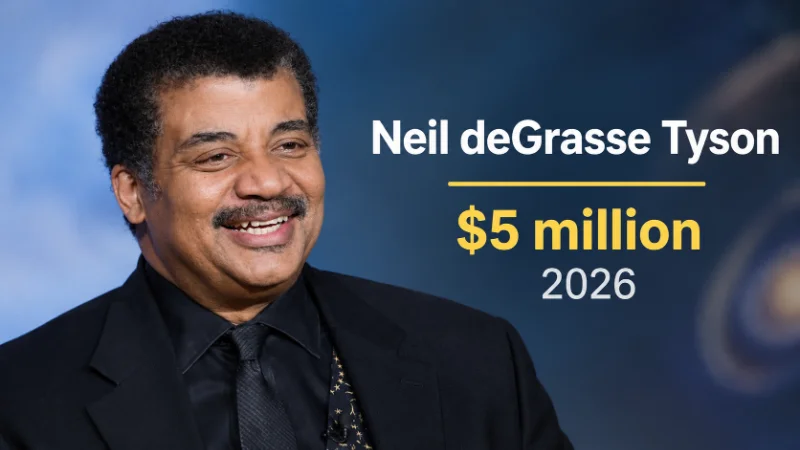
Neil deGrasse Tyson has an estimated net worth of $5 million, according to Celebrity Net Worth, the figure most often repeated for the astrophysicist and StarTalk host. That sits well below what many people expect from someone who fronted Cosmos, wrote a shelf of bestsellers, and turned up on late-night television for decades. The gap has a plain explanation, and it shows how Tyson built his career.
Tyson turned 68 on October 5, 2026, and he still directs the Hayden Planetarium in New York. His income comes from that museum post, television work, books, a long-running podcast, and a YouTube channel with 5.73 million subscribers. Below, the confirmed facts are separated from the guesswork, and each income stream is traced to its source.
How Much Is Neil DeGrasse Tyson Worth in 2026
The most consistent public estimate is $5 million. Celebrity Net Worth lists that total on its profile of Tyson, and a Yahoo Entertainment feature repeats it.
Treat it as an estimate, not a bank statement. Tyson has never published his finances, and no tax filing or asset record that would let a reader verify a total is public. Net worth pages for private individuals are built from outside guesses about pay, royalties, and appearance fees.
The figure is at least plausible. A museum director with decades of tenure, a catalog of books, and several hosting jobs would reasonably land in the low millions. Nothing public points to a fortune beyond that range.
Other numbers circulate, and most deserve suspicion. Smaller sites have posted totals anywhere from $2 million to $12 million, usually with no named source and often with recycled text. One profile put him at just over $2 million in early 2018, which shows how old figures keep circulating long after they stop being accurate.
Here is How the Claims Sort out:
| Category | What Is Confirmed / Reported |
|---|---|
| Confirmed | He has directed the Hayden Planetarium since 1996, hosted Cosmos in 2014 and 2020, and has published close to twenty books. |
| Widely Reported Estimate | A total of about $5 million, according to Celebrity Net Worth. |
| Unverified | His planetarium salary, per-season Cosmos pay, royalty totals, and speaking fees. |
Why the Number Looks Small Next to His Fame
Fame and wealth are different things, and Tyson’s career is built for the first one. His main job is a museum directorship, which pays a salary rather than equity. Nothing public suggests he owns a stake in Cosmos or in the StarTalk television run, which aired on Fox and National Geographic.
Speaking is where many well-known scientists earn the most, and Tyson has said he gives that income away. In a May 2011 StarTalk Radio episode, he said he donates all income he earns as a guest speaker, according to Wikipedia’s account of that episode. He has not publicly updated the statement, so it is unclear whether it still holds.
Several sites claim he commands five-figure speaking fees. None names a source, and the 2011 comment cuts against the idea that those fees add to his personal total.
The estimates also contradict each other in ways that expose how rough they are. A Yahoo Entertainment piece credits his books with roughly $6 million in royalties, which is more than the full $5 million estimate. Two small sites give his annual pay as $200,000 and $500,000, and both cannot be right. Readers should take every one of these figures as a guess.
Where Neil deGrasse Tyson’s Income Comes From
Four sources account for nearly everything public about his earnings. None of them has a confirmed dollar amount attached.
The Hayden Planetarium Directorship
Tyson joined the Hayden Planetarium as a staff scientist in 1994 and became acting director in June 1995. He was appointed director in 1996 and oversaw the $210 million reconstruction of the planetarium, finished in 2000. In 1997 he founded the Department of Astrophysics at the American Museum of Natural History, where he has been a research associate since 2003.

The salary is a private matter. A long-term museum post pays steadily whether or not a show is renewed, which gives the rest of his career a stable base.
Television, Streaming, and Guest Roles
Tyson hosted PBS’s NOVA ScienceNow from 2006 to 2011, then fronted Cosmos: A Spacetime Odyssey in 2014, a revival of Carl Sagan’s 1980 series. Celebrity Net Worth notes that he won a Critics’ Choice Television Award for Best Reality Show Host for that run. He returned for Cosmos: Possible Worlds on March 9, 2020.

Earlier work included the four-part NOVA Origins miniseries in 2004, narration of the 2009 documentary 400 Years of the Telescope, and narration of Food Evolution in 2016. National Geographic launched a StarTalk talk show on April 20, 2015, with Tyson interviewing celebrities about science.
He has also played himself on The Big Bang Theory, Family Guy, and Futurama, took part in Celebrity Jeopardy! in 2025, and appeared 22 times on The Late Show with Stephen Colbert between 2015 and 2026, including the series finale. Pay for these cameos is not public, but they keep his name in front of the audience that buys his books.
Books and Royalties
Astrophysics for People in a Hurry, published in 2017, is his best-known title. It earned a Grammy nomination for Best Spoken Word Album in 2018, and Yahoo Entertainment reports it has sold more than a million copies. Later titles include Letters from an Astrophysicist (2019), Cosmic Queries (2021), Starry Messenger (2023), and Take Me to Your Leader, a 2026 release.
Royalty income depends on contract terms that authors rarely disclose. Wikipedia lists close to twenty titles under his name, so the catalog is large, but sales figures beyond the million-copy claim are not public.
StarTalk, YouTube, and Podcasting
StarTalk began as a one-hour radio show in May 2009, co-hosted with comedian Lynne Koplitz. It ran 13 weeks, returned in December 2010 with Chuck Nice and Leighann Lord, and grew into a podcast, a YouTube channel, and the National Geographic series. Rolling Stone placed the show on its 2014 list of the 20 best comedy podcasts, per Celebrity Net Worth.

The YouTube channel has 5.73 million subscribers and about 1.022 billion views, according to Wikipedia, and it won a YouTube Gold Creator Award in 2020. Those numbers suggest meaningful advertising and sponsorship revenue, but Google does not publish per-channel earnings, so any dollar figure is a guess.
How His Earning Power Grew Over Three Decades
Tyson’s early career was not a straight climb. He earned a physics degree from Harvard in 1980 and a master’s in astronomy from the University of Texas at Austin in 1983, but by his own account he spent too little time in the lab, and his doctoral committee there was dissolved. He rebuilt at Columbia, finishing a PhD in astrophysics in 1991 under R. Michael Rich.
Money-wise, those years were modest: a lecturer post at the University of Maryland from 1986 to 1987, graduate funding, and a three-year postdoc at Princeton. Public pay records for those jobs do not exist, but postdoctoral pay is modest by nature.
The planetarium directorship in 1996 gave him a platform and a steady paycheck. From 1995 to 2005 he wrote the Universe column for Natural History magazine, and Time named him one of the 100 most influential people in the world in 2007. The turning point for his earning power came in 2014, when Cosmos put him in front of a prime-time audience on Fox and National Geographic.
After Cosmos, offers multiplied: the 2015 talk show, books on the bestseller shelf, and guest roles across animated and live-action shows. Older net worth profiles sit lower, while pages updated after 2014 mostly settle near $5 million. That pattern fits a career that earned most of its money after Cosmos, though the exact split is not public.
The 2018 Allegations and the Effect on His Work
In November and December 2018, a woman accused Tyson of drugging and raping her in 1984, and three other women alleged inappropriate advances. He denied the rape accusation and said his actions in the other matters were misinterpreted, apologizing for any offense.
National Geographic paused StarTalk on January 3, 2019, and the Cosmos: Possible Worlds premiere was delayed. On March 15, 2019, Fox and National Geographic announced the investigation was complete and both shows would continue. In July 2019, the American Museum of Natural History said he would keep his job as planetarium director.
No public figure shows what the pause cost him in income. Every major role continued afterward, and Cosmos: Possible Worlds aired in March 2020.
Lifestyle, Home, and What Is Not Public
Tyson lives in Tribeca in Lower Manhattan with his wife, Alice Young, whom he met in a physics class at the University of Texas at Austin. They married in 1988 and have two children, Miranda and Travis. A 2003 New York Times feature described his Tribeca loft as having 14-foot ceilings.
He is also a wine enthusiast, and his collection was featured in Wine Spectator in May 2000 and The World of Fine Wine in spring 2005. No source gives a value for the home, the wine, or any investments, so none of it feeds into a verified total.
What Could Move the Estimate Next
Several current projects could affect how outlets revise their numbers. Take Me to Your Leader is a 2026 title, StarTalk continues weekly, and his run on The Late Show ended with the series finale in 2026. A new television series would draw fresh headlines, though the pay behind it would still not appear in public records.
Because estimates change slowly, expect the $5 million figure to stay put until a site finds a new reason to revise it. Any update would reflect a recalculation by that site, not a disclosure from Tyson.
What His Net Worth Says About Science Communication
Tyson’s estimated wealth is modest for someone so widely recognized, but wealth is a poor measure of what he has done. As planetarium director he kept Pluto from being labeled the ninth planet in exhibits, years before the International Astronomical Union reclassified it in 2006. He also told the Senate science committee in March 2012 that NASA’s budget was half a penny on the tax dollar, a line that inspired the Penny4NASA campaign.
Recognition has come as honors, not equity: the NASA Distinguished Public Service Medal in 2004, the National Academy of Sciences Public Welfare Medal in 2015, and the Stephen Hawking Medal for Science Communication in 2017. An asteroid, 13123 Tyson, carries his name.
A reader checking his net worth will find a figure near $5 million that changes little from year to year. The better measure of his career is reach: a planetarium he rebuilt, a Sagan series he helped revive, and a podcast that has run for more than 15 years.