

Claude Akins had an estimated net worth of $2 million at the time of his death in January 1994, according to Celebrity Net Worth. He built that fortune over four decades as a character actor, moving from Broadway stages to Hollywood westerns and eventually to the lead role that made him a household name: Sheriff Elroy P. Lobo.
Quick Facts
| Detail | Information |
| Full Name | Claude Marion Akins (also recorded as Claude Aubrey Akins) |
| Net Worth | $2 million (estimated, at death) |
| Profession | Actor |
| Born | May 25, 1926, Nelson, Georgia |
| Died | January 27, 1994, Altadena, California |
| Primary Income Source | Film and television acting |
| Best Known For | Sheriff Lobo in “B.J. and the Bear” and “The Misadventures of Sheriff Lobo” |
Early Life and Military Service
Akins grew up in Georgia and later served with the U.S. Army Signal Corps in the Pacific during World War II. After the war, he enrolled at Northwestern University, where he majored in theater arts and trained in Shakespeare, graduating in 1949.
That theater training led him to the Barter Theater in Abingdon, Virginia, his first professional stage work. From there he moved to Broadway in the late 1940s, landing a role in “The Rose Tattoo.” The stage work gave him the presence and vocal control that would define his screen career: a large frame, a deep voice, and a face that could play either side of the law convincingly.
Breaking Into Hollywood
Akins made his film debut in 1953 with “From Here to Eternity,” followed a year later by “The Caine Mutiny.” Talent agent Meyer Mishkin signed him soon after, placing him among a group of character actors nicknamed “Mishkin’s Band of Uglies,” which also included Lee Marvin, Charles Bronson, and Chuck Connors.
Low-budget productions of that era often expected actors to perform their own stunts to cut costs. Akins later described being run over by a wagon during one western shoot, a detail that captures how physical the work was for jobbing actors in the 1950s.

Through the rest of that decade and into the 1960s, Akins built a reputation as a reliable tough guy, appearing in films such as “Rio Bravo,” “Comanche Station,” “Merrill’s Marauders,” “The Devil’s Brigade,” and “Return of the Seven.” None of these were starring roles, but steady casting across major studio westerns and war pictures kept him working and earning consistently, which is the real engine behind his eventual net worth.
This period matters for understanding his finances because character actors of that era rarely earned large single paychecks. A supporting role in a studio western paid a flat fee for the shoot, with no ownership stake in the film and no long-term royalty. The money came from volume: staying booked across many productions a year, rather than negotiating a large payday for any one part. Akins worked that way for roughly two decades before television gave him a different kind of earning path.
Building a Career on Television
Where Akins made most of his money, and most of his name, was television. Across the 1950s and 1960s he appeared repeatedly on western anthology and episodic shows, including “Wagon Train,” “The Restless Gun,” “The Rifleman,” “Daniel Boone,” and “The Big Valley.” Recurring guest spots on popular series were a dependable income stream for character actors of his generation, since a working actor could hold multiple appearances across several long-running shows in a single year.
That steady television work set up the two roles that defined the second half of his career. It also meant Akins was a familiar face to American audiences well before “Movin’ On” or “Sheriff Lobo” made him a lead. Casting directors already knew what he could do, which is part of why networks were comfortable handing him a starring vehicle in his late 40s, an age when many film actors of the period saw their opportunities narrow rather than expand.
Movin’ On and the Rise to Leading Roles
In 1974, Akins landed his first true starring role, playing independent long-haul trucker Sonny Pruitt in “Movin’ On,” alongside Frank Converse. The show ran for 45 episodes over two seasons on NBC and rode the mid-1970s wave of trucking culture in American film and television. Merle Haggard wrote and performed the theme song, which reached number one on the Billboard Hot Country Singles chart in July 1975.
A starring television role, rather than a supporting film part, marked a real jump in Akins’ earning power. Series leads command higher episodic fees than guest or supporting actors, and “Movin’ On” gave him that status for the first time.
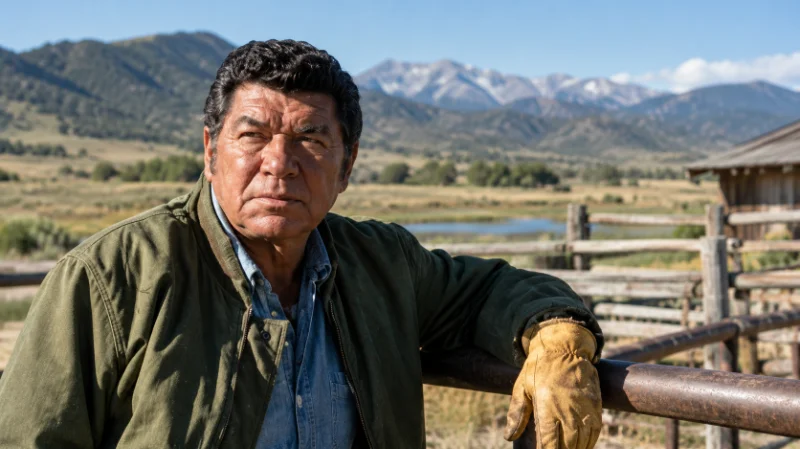
The show also cast him against type in one sense. Sonny Pruitt was a working man’s hero rather than a villain, and the warmth Akins brought to the role helped him carry a weekly series as its top-billed actor, something his earlier resume of tough guys and heavies had not fully signaled he could do. The series ran for two seasons before ending in 1976, but it proved he could anchor a show, which set up the offer that came two years later.
Sheriff Lobo and Peak Earning Years
Akins’ best-known role began as a recurring character on “B.J. and the Bear” in 1978: Sheriff Elroy P. Lobo, a corrupt, scheming county sheriff obsessed with catching the show’s trucker hero. The character was popular enough that NBC spun him off into his own series, “The Misadventures of Sheriff Lobo,” which ran from 1979 to 1981 and was renamed “Lobo” for its second season.
This was Akins’ most commercially successful period. A starring role on a network spin-off, combined with the residual income that comes from a show airing widely in syndication for years afterward, represents the core of his later-career earnings.

Off screen, his newfound recognizability made him a sought-after pitchman. Akins appeared in TV commercials for PoliGrip, AAMCO Transmissions, and Rollins Truck Leasing in the late 1970s and early 1980s, an income stream separate from his acting fees that added to his overall earnings during his most visible years.
“The Misadventures of Sheriff Lobo” was cancelled after its second season when NBC shifted the show’s setting from a rural Georgia county to urban Atlanta, a change that alienated much of the audience that had made the original character popular. Even after the cancellation, Akins kept working steadily through the 1980s in guest roles and television movies, a pattern that kept income flowing without ever again reaching the earning peak of his two starring series.
Income Sources and Career Earnings
Akins’ income came from several channels rather than one blockbuster payday:
Film acting fees across nearly 100 movie credits between 1953 and the early 1990s. Television guest and recurring appearances, with more than 180 episode credits across dozens of series. Starring salaries from “Movin’ On” and “The Misadventures of Sheriff Lobo,” his two highest-paying regular roles. Syndication residuals from “B.J. and the Bear” and “Sheriff Lobo,” which continued to air for years after production ended. Commercial endorsement deals, most notably for AAMCO and PoliGrip.
No single source publishes a detailed breakdown of exactly how these income streams combined into his final estate value. The widely cited $2 million figure comes from aggregate estimates rather than a disclosed financial record, which is normal for actors of his generation who worked before modern celebrity finance reporting existed. Specific figures for real estate, vehicles, or other personal assets are not independently confirmed in any named source, so this article does not present a breakdown of his physical assets as fact.
Personal Life and Final Years
Akins married Therese Fairfield in 1952, and the two remained married until his death, raising three children together. He kept working through the late 1980s and into the early 1990s, taking film and television roles even as his health declined.
He died of cancer on January 27, 1994, in Altadena, California, at age 67. Obituaries at the time noted him specifically as the actor behind Sheriff Lobo and the AAMCO pitchman, a sign of how closely the public had come to associate him with those two identities by the end of his life.
Across a career that began in 1953 and ran until the early 1990s, Akins amassed nearly 100 film credits and more than 180 television episode credits. Few actors of his generation worked that consistently across both formats for four decades, and that consistency, rather than any single blockbuster, is what built his estate.
How Claude Akins’ Net Worth Compares to Peers
A $2 million estate places Akins below the marquee stars of his era but in line with many working character actors who built decades-long careers without ever landing a top-billed film franchise. Actors like Chuck Connors and Michael Ansara, who worked similar circuits of westerns and episodic television, are generally estimated in comparable ranges. The consistency of Akins’ income, built on volume of work rather than a small number of high-paying roles, is the more instructive story than the raw dollar figure itself.
That pattern still describes a large share of Hollywood’s working actors today: fewer huge paydays, more sustained income from a steady stream of supporting and recurring roles.
It also explains why his net worth has stayed a flat, stable figure across the estimate sites that track it, rather than a number that has been revised upward or downward over the years. There is no new project, re-release, or licensing deal generating fresh income for his estate, so the $2 million estimate from the time of his death has simply carried forward as the standing figure.